Gleeson Homes Ivy Mills, Hensingham: New Builds Stripped Back to Breezeblock for NHBC Remedial Works in West Cumbria
Empty new build properties on Gleeson Homes' Ivy Mills development in Hensingham, on the eastern edge of Whitehaven in West Cumbria, are being taken apart and rebuilt at the front corners after failing to meet National House Building Council (NHBC) standards, the housebuilder has confirmed.
According to a report published by Cumbria Crack on 15 April 2026, bricks have been removed from the front corners of at least four homes on the estate, exposing the inner blockwork beneath, and timber hoardings and tarpaulin have been erected around the affected plots to screen the works from the roadside.
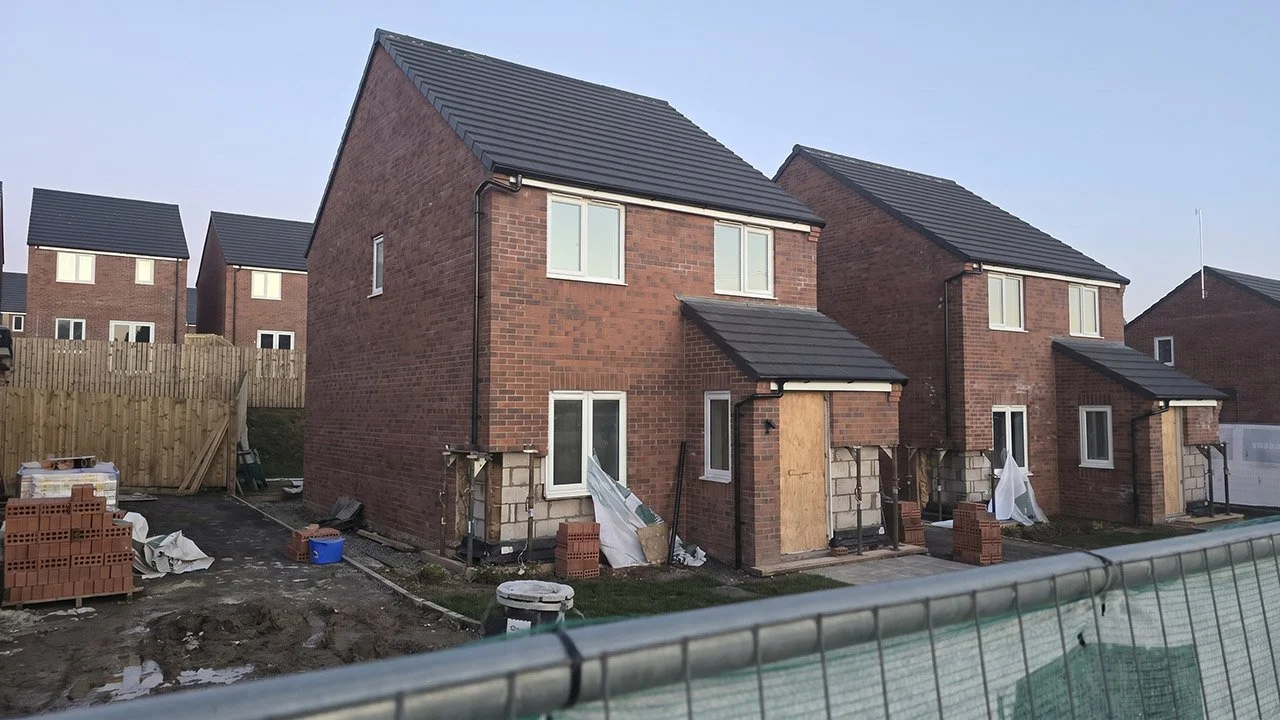
The unusual sight of partially stripped facades on a brand new development sparked speculation locally that the houses were suffering from subsidence, a particular concern given that the estate sits on the cleared footprint of a demolished factory. Gleeson Homes has firmly rejected that suggestion. A spokesperson for the company told Cumbria Crack: "There is no subsidence affecting the properties at Ivy Mills, and no underpinning work is required or taking place. The work currently being undertaken relates to technical remedial activity on a number of homes in line with NHBC requirements. This is a technical compliance matter and not linked to any structural defect or ground instability." The developer declined to say how many properties in total were affected.
A short history of the Ivy Mills site
Ivy Mills sits on Main Street in Hensingham, on the site of the former Romar Innovate factory. Romar, a workwear and personal protective equipment manufacturer founded in 1987 by John and Linda Rowlands, downsized to Leconfield Industrial Estate in Cleator Moor in 2018 after losing a major Sellafield PPE contract to Arco, and the Hensingham factory was demolished and the site cleared in 2017. Outline planning permission for up to 29 homes followed that year.
Sheffield-headquartered Gleeson Homes, the affordable housing arm of London-listed MJ Gleeson plc, picked up the land and was granted full planning permission for the first 26 homes in December 2021. Construction of phase one began in February 2022 and was completed in 2023, with the first residents moving in that spring. A second phase of 63 homes, a mix of two, three and four-bedroom properties, was approved by the local authority in July 2024, with work starting that summer and the first plots expected to be released for sale during 2025. As part of the second phase, Gleeson contributed more than £95,000 towards the local drainage network under a Section 106 agreement.
Gleeson Homes is one of the larger affordable housebuilders in the north of England. MJ Gleeson plc's audited results for the year ended 30 June 2025 confirm that Gleeson Homes sold 1,793 homes in FY2025, up slightly from 1,772 the previous year, and the board has set a medium-term target of "selling 3,000 new homes per annum", at which level it has said group profitability "could broadly triple". The company runs a dedicated Cumbria region with sites in Carlisle, Workington, Maryport, Egremont, Aspatria, Wigton and Barrow-in-Furness, plus a second Whitehaven development at Saltom Bay Heights on the western side of the town. It markets itself heavily to first-time buyers and key workers.
What "technical compliance" with NHBC standards means in practice
Although neither Gleeson nor the NHBC has publicly specified the precise defect at Ivy Mills, the visible scope of the works, brick removal limited to the front corners of the properties rather than the full elevation, points strongly to a masonry issue covered by Chapter 6.1 of the NHBC Standards, which deals with external masonry walls.
The corners (or "quoins") of a brick-built home are one of the most demanding parts of any masonry construction. They concentrate vertical and horizontal loads, they are where the bonding pattern of the brickwork has to turn through 90 degrees without losing alignment, and they are where wall ties, lintels and movement joints all have to be coordinated. Chapter 6.1 of the NHBC Standards is unusually specific about each of these. Wall ties, for example, must be spaced at no more than 900mm horizontally and 450mm vertically across the general wall area, but the spacing must tighten significantly near openings, with ties required "within 225mm of opening" and at "not more than 300mm" vertical centres, and each tie must be embedded a minimum of 50mm into both leaves of masonry. Vertical movement joints, used to allow clay brickwork to expand without cracking, must run the full height of the wall, and the first joint from a corner "should be no more than half the standard dimension". Bonding rules are equally strict: "a regular bonding pattern should be maintained" and builders must "avoid irregular or broken bonds, particularly at openings".
Any one of these requirements being missed, mis-set or installed outside tolerance can be enough to trigger a fail at NHBC's pre-handover inspection. Because the NHBC Buildmark warranty is what underpins almost every mortgage on a new build, the only options when an inspector flags the front corner of a house as non-compliant are to take the masonry down, correct the underlying defect, and rebuild it, exactly the work residents at Ivy Mills can now see going on behind the tarpaulin. The scale of NHBC's role makes this hard to ignore: in its own written evidence to the UK Parliament's Housing Committee, the council describes itself as "the UK's largest new home warranty and insurance provider, covering 70-80% of newly-built homes each year in the UK and protecting approximately 1.4 million policyholders", a figure corroborated by the Competition and Markets Authority's Housebuilding Market Study Final Report of 26 February 2024.
It is worth being clear that the NHBC Standards are not legislation. They sit alongside, and sometimes above, Building Regulations, providing the technical benchmark by which the NHBC decides whether to issue or honour its 10-year warranty. That warranty splits into a two-year defects period, during which the builder is responsible for putting things right, followed by an eight-year structural and weatherproofing cover from the NHBC itself.
Why this matters for new build buyers
The Ivy Mills situation is a useful, if uncomfortable, reminder of how often new build defects, including ones that look serious from the outside, are discovered after construction has finished. The most recent national figures from the Home Builders Federation's 2026 customer satisfaction survey show that 93 per cent of buyers would recommend their builder, but earlier rounds of the same survey paint a more sobering picture of defect rates: the March 2025 HBF National New Homes Customer Satisfaction Survey, as cited by the HomeOwners Alliance, found that "93.7% of new build buyers reported problems to their builder since moving in and over a quarter reported more than 15 snags". Professional snagging firms typically log far more, with The Professional Snagging Company stating that it finds "on average 150+ items during our snagging surveys".
Some of those issues are cosmetic, paint splashes, scuffed skirting, ill-fitting doors. Others, like incorrectly spaced wall ties, missing cavity trays or poorly bonded brickwork at corners, are structural in nature and considerably harder to spot from inside a finished living room. That is exactly why an independent professional snagging inspection has become a near-standard step for cautious new build buyers, particularly during the first two years when the builder is contractually obliged to fix anything that fails to meet NHBC requirements.
Snagging.org's sponsor, New Build Inspections, is one of a small number of firms whose inspectors work only for buyers, never for developers, and whose reports are designed to be referenced directly against the relevant NHBC chapter so that defects can be itemised, reported through the housebuilder's customer care portal, and re-inspected once the remedial work is done. For a property at the upper end of the Ivy Mills price range, around £240,000, the cost of a full snagging survey is typically a small fraction of one per cent of the purchase price, and the leverage it provides during the warranty window is significantly greater than trying to argue defects after the fact.
What Ivy Mills residents and prospective buyers should take from this
The encouraging part of the Ivy Mills story is that the system is, in this instance, working as designed. The NHBC has identified a problem, the homes in question are unoccupied, and Gleeson is correcting the defect at its own cost before any sale can complete. The less reassuring part is that the issue was significant enough to require bricks to come down on multiple homes, on a development that has been on site since 2022 and where a first phase has already been handed over.
For anyone who has already bought or reserved at Ivy Mills, the practical advice is straightforward: log any concerns through the My Gleeson customer care portal, request written confirmation from the developer that the property has passed its NHBC pre-handover inspection, and consider commissioning an independent snagging survey within the two-year defects period. For prospective buyers across the rest of Gleeson's Cumbria region, and indeed across the wider new build market, the Ivy Mills works are a timely reminder that "new" does not automatically mean "fault-free", and that the NHBC standard, while a strong baseline, is only as effective as the inspections, both official and independent, that hold builders to it.